
Gutter Guards3 min read
Micro-Mesh vs. Screen Guards: Which Handles Cottonwood Leaves?
For cottonwood leaves and seed fluff, stainless micro-mesh outperforms plastic or aluminum screens. Screens stop big leaves but let seeds and fragments through. Here’s the comparison.
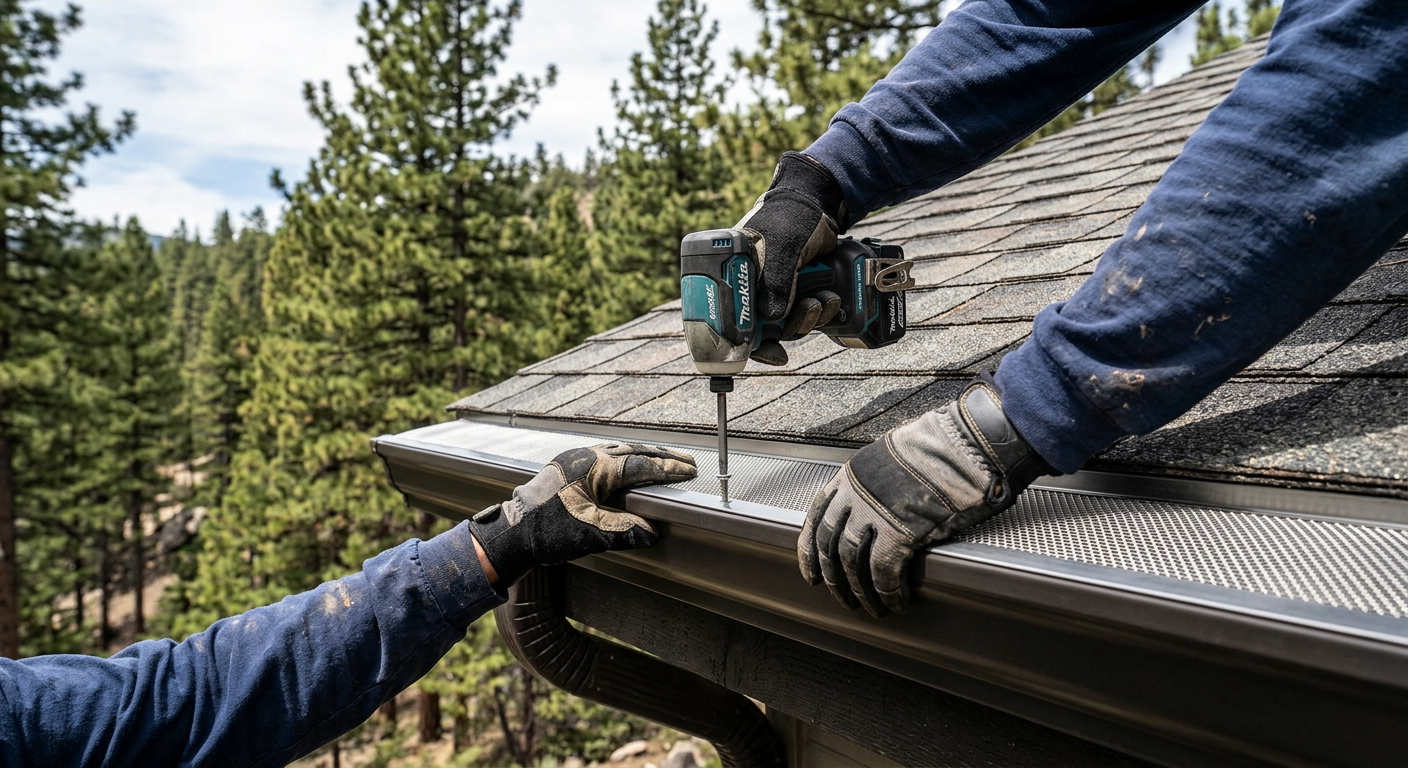
If cottonwoods are your main problem, stainless steel micro-mesh is the better guard. Standard screens stop whole cottonwood leaves, but the small leaf fragments, catkins, and spring seed fluff pass through the openings and collect underneath, where they’re hard to clean. Micro-mesh has openings small enough to block nearly all of it, and the debris sits on top where wind and rain carry most of it off.
Carson City is a good example of why this matters. Neighborhoods along the Carson River and the older tree-lined streets near downtown have mature cottonwoods that drop leaves in fall and cotton in late spring. Homeowners there often install screens, then find the gutters clogged anyway a year later.
How screen guards work
Screen guards are panels of plastic or aluminum with holes roughly a quarter to a half inch wide. They snap or slide under the first row of shingles and sit over the gutter. They’re inexpensive and easy to install, and they keep out big leaves and sticks.
- Good at: blocking whole leaves, sticks, and pine cones
- Weak at: seed fluff, catkins, leaf fragments, and pine needles, which slip through the holes
- Plastic screens get brittle in high-desert sun and can crack after a few seasons
- Lightweight panels can lift or blow out in strong wind
How micro-mesh guards work
Micro-mesh is a fine stainless steel mesh stretched over a rigid aluminum frame. The openings are tiny, so water passes through by surface tension while nearly all debris stays on top. The frame is fastened to the gutter itself, which keeps it in place through wind and snow.
- Good at: cottonwood fluff, elm seeds, pine needles, shingle grit, and leaves
- Stainless steel doesn’t get brittle in UV like plastic does
- The rigid frame supports snow load without sagging into the gutter
- Costs more up front than screens, but rarely needs replacing
The cottonwood test
Cottonwood is the hardest test for a guard because it brings two kinds of debris. In fall you get large, waxy leaves that blanket the roof. In spring you get cotton, which is light and sticky and clings to anything with an edge. Screens catch the cotton in their holes, where it mats into a felt layer. Micro-mesh is smooth enough that the cotton dries and blows away.
Maintenance on either type
No guard is maintenance-free. Expect to brush debris off micro-mesh once or twice a year, more under heavy trees. With screens, you’ll need to pull panels to clean out what got through underneath. That’s usually the deciding factor: brushing the top is a few minutes from a ladder, pulling panels is a full cleaning job.
Which should you choose?
If you only deal with a few broadleaf trees and no pines or cottonwoods, a quality screen can work fine. If you live near cottonwoods, pines, or elms, micro-mesh will save you cleanings and frustration. Either way, guards only work on gutters that are sound and pitched correctly, so we check the gutters before recommending anything.
Battle Born Gutters installs leaf guards in Carson City, Reno, and throughout Northern Nevada. Call (775) 414-4526 for a free estimate and side-by-side guard options.